How to Insure and Catalog a Growing Collection
How do I track and protect a bigger collection?
On this page
Why Bother Cataloging and Insuring at All?
Be honest: have you ever stood in a record store, spotted a sealed copy of an album, and bought it—only to get home and find the same record already wedged in your shelf? That "I forgot I owned that" moment is funny once. Done a few times, it's real money spent on duplicates you didn't need. A simple catalog is the cure: when you can glance at a list (or an app on your phone), you stop buying blind and start filling actual gaps in your collection.
The less fun reason is disaster. Theft, a burst pipe, or a small fire can erase a shelf of arcade boards, cassettes, or vintage toys in minutes. If nothing is documented, you're left trying to prove what you owned from memory—and that almost never goes well.
Here's the kicker most people miss: standard homeowners and renters policies usually do not fully cover collectibles. They cap payouts on "valuables" and often exclude items they don't understand. A catalog with photos and rough values is exactly what you'll need to add a rider or file a claim. It protects your money on both ends—what you spend and what you'd lose.
Step 1: Start a Simple Catalog (Free Tools That Actually Work)
Here's the good news: you don't need fancy software or a weekend-long spreadsheet bender to get organized. You just need to start. The collectors who never catalog are usually the ones who imagine some perfect, exhaustive system and then never build it. Skip that. A "good enough" list you actually keep is worth ten databases you never finish.
Decide what to track (keep it to six columns)
Resist the urge to log everything. For a mixed retro collection, these six fields cover you for both memory and insurance:
- Item — your own plain-language description (e.g., "Star Wars Kenner Boba Fett, no missile," not the eBay seller's all-caps title)
- Year/era — the actual release year if you know it; an approximate decade if you don't
- Condition — sealed, near-mint, played-with-but-loved, etc.
- What you paid — past-you will forget, guaranteed
- Current value — a ballpark from recent sold listings
- Photo — one clear shot, more if there's damage
Free and cheap tools, ranked by effort
- Google Sheets — free, syncs everywhere, and you can paste photo links right into cells. Start here if you're unsure.
- Airtable — also free at the starter tier; nicer if you like attaching real photos and filtering by category.
- Phone notes — fine for a quick capture in the moment, rough for managing 200 items.
- Dedicated apps — Discogs is the gold standard for vinyl (it auto-pulls release info and price history). CLZ and Sortly handle mixed collections with built-in barcode scanning and photo storage.
Spreadsheet vs. app for a mixed haul
A spreadsheet wins on flexibility — vinyl, cassettes, arcade boards, and loose action figures all coexist in one tidy grid you fully control. Apps win on convenience: scan a barcode, get instant value data, snap photos in-app. The honest answer for most retro collectors? Use Discogs for your records and one Google Sheet for everything else.
Quick-start plan
Don't try to do it all at once. Photograph in batches — pull ten items, shoot them on a plain background, then log those ten. Ten a day means a 200-piece collection is fully cataloged in about three weeks, with zero headaches.
Step 2: Photograph and Document for Proof of Ownership
Here's the part everyone skips until they wish they hadn't: if a pipe bursts or a box walks off, your memory of "that mint-condition Star Wars figure" won't cut it with an insurer. Photos and paperwork will.
Shoot it like it matters. Use daylight near a window or a cheap clip-on LED, and lay items on a plain background. Take one clean overall shot, then close-ups of the stuff that drives value: serial numbers, date stamps, label text, and—just as important—the flaws. That ring wear on the vinyl, the price sticker ghost on a cassette J-card, the chipped paint on a die-cast car. Honest condition photos protect you at claim time and build trust if you ever resell.
Save the paper trail. Tuck away receipts, original boxes, and any provenance notes ("bought at the 2019 Chicago record show," "came from my uncle's garage"). Even a quick typed note about where and when you got something adds credibility.
Back it up off-site. Store photos and docs in Google Drive, iCloud, or Dropbox—free tiers handle thousands of images. The whole point is that your proof survives the same flood or fire as your collection, so don't keep it only on a laptop in the same room.
Track the total. Add a "value" column to your catalog and update it as you buy. Once that running tally climbs past a few thousand dollars, you'll know it's time to talk coverage.
Step 3: Figure Out What Your Collection Is Actually Worth
Before you can insure anything, you need a realistic number — and here's the first rule: ignore asking prices. That mint-condition Star Wars Kenner figure listed at $300 doesn't mean yours is worth $300. What matters is what people actually paid.
Check sold listings, not wishful ones. On eBay, filter your search by "Sold Items" to see real transactions. For records, Discogs shows historical sale prices right on each release page. Look at a few recent sales in similar condition to find a fair middle.
Self-estimate vs. appraisal. For most items — common LPs, '80s toys, cassettes — your own sold-listing research is plenty. Consider a professional appraisal only when a single piece could fetch roughly $500 or more, or for rare graded items where condition heavily swings value.
Group the small stuff, schedule the stars. Insurers let you bundle dozens of low-value items under one "blanket" amount, while high-value pieces get individually listed ("scheduled") with documentation. That mix keeps premiums sane.
Revisit yearly. Retro markets swing — a franchise reboot or a viral moment can spike prices overnight. A quick annual check keeps your coverage honest.
Step 4: Insurance Basics for Collectors
Here's the part nobody warns you about: your homeowners or renters policy probably won't fully cover that shelf of sealed Star Wars figures or your crate of first-press vinyl. Standard policies cap payouts on "collectibles" — often somewhere around $1,000–$2,500 total — and they frequently exclude the things most likely to happen, like accidental drops, slow water damage, or a record warping in a hot attic. If your collection has quietly grown past a few hundred dollars in value, you've probably outgrown that default coverage without realizing it.
Good news: you have two beginner-friendly options, and neither requires a finance degree.
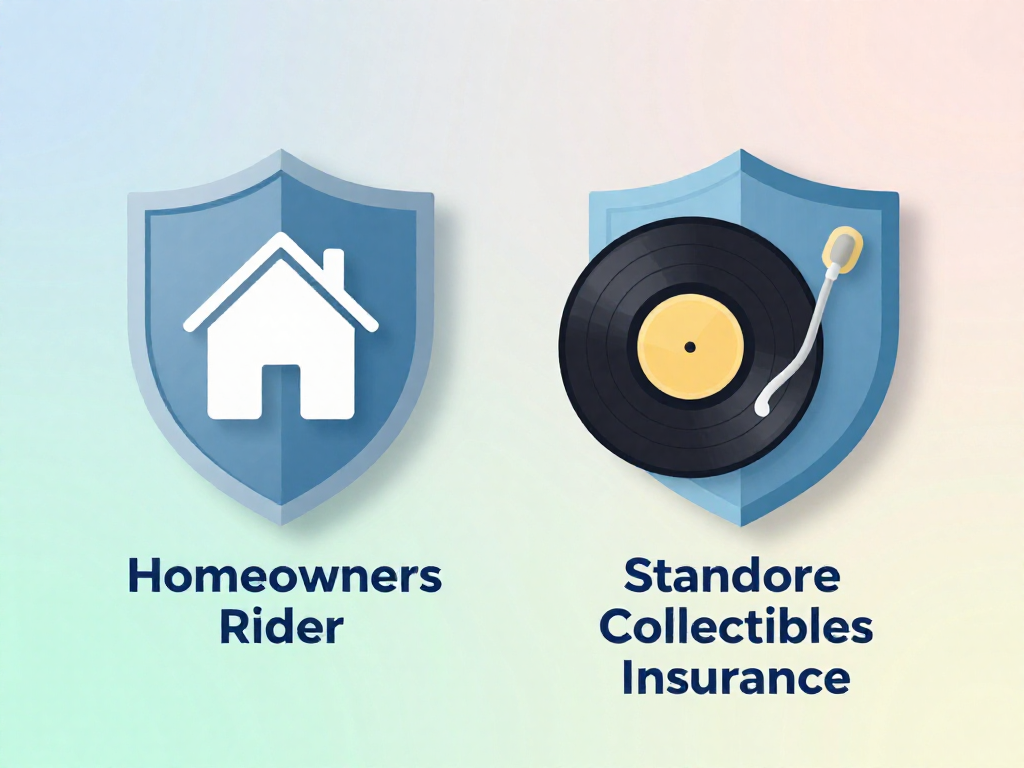
Option 1: Add a rider to what you already have. Ask your current insurer about scheduled personal property (sometimes called a "floater" or "rider"). You list specific items with their values — backed by the photos and appraisals from Steps 2 and 3 — and pay a small annual premium, often just a few dollars per $100 of coverage. This is the easiest path if your collection is modest or centered on a handful of standout pieces.
Option 2: Standalone collectibles insurance. Specialty insurers focus on hobbies like comics, toys, and records, and tend to offer broader perils and friendlier claims for collectors. It's usually worth pricing out once your collection climbs into the thousands, or if you display, travel with, or sell items.
Before you sign anything, ask these four questions:
- What perils are covered? Look for fire, theft, water, and accidental damage — not just the basics.
- What's the deductible? A low premium with a $500 deductible may not help on a $200 loss.
- Agreed value or actual cash value? Agreed value pays the amount you documented up front. Actual cash value subtracts for age and wear — rarely your friend with collectibles.
- How are values updated? Markets move; make sure you can re-schedule items as they appreciate.
Start with a quick call to your existing agent. Five minutes often tells you whether a simple rider does the job or it's time to shop around.
Keeping It Up to Date Without Burning Out
Here's the truth: the catalog you abandon is worse than no catalog at all, because you think you're covered when you're not. The trick is making upkeep so painless you barely notice it.
Log it the moment it lands. When that boxed Star Wars figure or sealed cassette shows up, snap a photo and add the row right then — purchase price, date, where you got it. "I'll do it someday" is how 40 untracked items pile up.
Block 15 minutes each quarter. Four times a year, skim for missing photos, update any values that have jumped, and tidy loose entries. Set a phone reminder so you don't have to remember.
Watch your total. When your catalog value climbs roughly 20–25% above your insured amount, call your provider and bump the limit. Keep the catalog total and your policy value in sync — that's the whole game.
FAQ
Does homeowners insurance cover my collectibles?
Partly, but probably not the way you'd hope. A standard homeowners or renters policy usually covers personal property, including your collection, against things like fire and theft. The catch is that most policies cap certain categories and reimburse "actual cash value" (what your stuff is worth used), not what it would cost to replace a rare item. Many policies also carry sub-limits that can fall short for a valuable group of pieces. The fix is to call your insurer and ask two questions: what's my limit on collectibles, and can I add a scheduled rider (sometimes called a floater) for high-value items? Scheduling lists specific pieces at agreed values so you're covered for the real number, not a guess.
What's the easiest free app to catalog a collection?
Honestly, the easiest free tool is one you already have: a spreadsheet in Google Sheets or Excel, plus your phone's camera. Make columns for item name, year, condition, what you paid, estimated value, and where you bought it, then snap a photo of each piece. It's free, it backs up to the cloud, and it exports easily if your insurer ever asks for proof. If you want something purpose-built, hobby-specific apps like Discogs (great for vinyl and cassettes) let you scan barcodes and pull in release details automatically, and many collectible categories have their own free trackers. Start simple — a half-filled spreadsheet beats a perfect app you never open.
Do I need a professional appraisal to insure my collection?
Not always. For everyday collections of modest value, your own documented records — clear photos, purchase receipts, and reasonable value estimates — are often enough to add coverage. You typically only need a professional appraisal when you want to schedule individual high-value pieces, because the insurer wants an independent, agreed value before they'll cover that amount. A good rule of thumb: if losing one item would genuinely hurt financially, get that piece appraised. For the rest, keep solid documentation and revisit it every couple of years, since values for retro items can drift up or down as nostalgia trends shift.
How much does collectibles insurance cost?
Less than most people fear. Dedicated collectibles policies often run somewhere around 1% to 2% of the collection's value per year, so insuring a $5,000 collection might cost roughly $50 to $100 annually, though rates vary by category, location, and how you store everything. Adding a scheduled rider to your existing homeowners policy is usually even cheaper for a handful of items. Costs go down when you reduce risk — think a dry, climate-controlled space and decent locks. Get a couple of quotes before committing; specialty collectibles insurers sometimes beat a homeowners add-on, and it only takes a few minutes to compare.
What information should I record for each item?
Capture enough that a stranger could identify the piece and confirm its worth. For each item, record: the name and a short description in your own words, the year or era it's from, the manufacturer or label, its condition (be honest — note any wear, fading, or repairs), what you paid and when, where you got it, and your best current value estimate. Add at least one clear photo, plus close-ups of any markings, serial numbers, or damage. Keep receipts or screenshots of comparable sales if you have them. This same record doubles as your insurance proof and your personal history of the hunt — which, let's be honest, is half the fun.
See also
- Beginner's guide to grading and condition for retro items
- How to spot fakes and reproductions when collecting
- Where to buy retro collectibles without overpaying
- How to store and display vinyl, cassettes, and toys safely
Related articles
Why We Get So Nostalgic for the 90s, According to Memory
Why does retro stuff make us so nostalgic? The memory science behind 90s nostalgia—and why we collect the toys, tapes, and games of our childhood.
Jun 27, 2026 · 10 min read

How to Negotiate Prices Without Being Awkward About It
Learn how to negotiate prices on retro collectibles without the awkwardness. Friendly scripts, fair offers, and beginner tactics for vinyl, toys, and more.
Jun 27, 2026 · 7 min read
A Quick Glossary of Collecting Terms Every Beginner Should Know
Confused by MIB, NM, repro, and OOP? This beginner-friendly glossary explains the retro collecting terms you'll see on eBay, in groups, and at flea markets.
Jun 27, 2026 · 5 min read